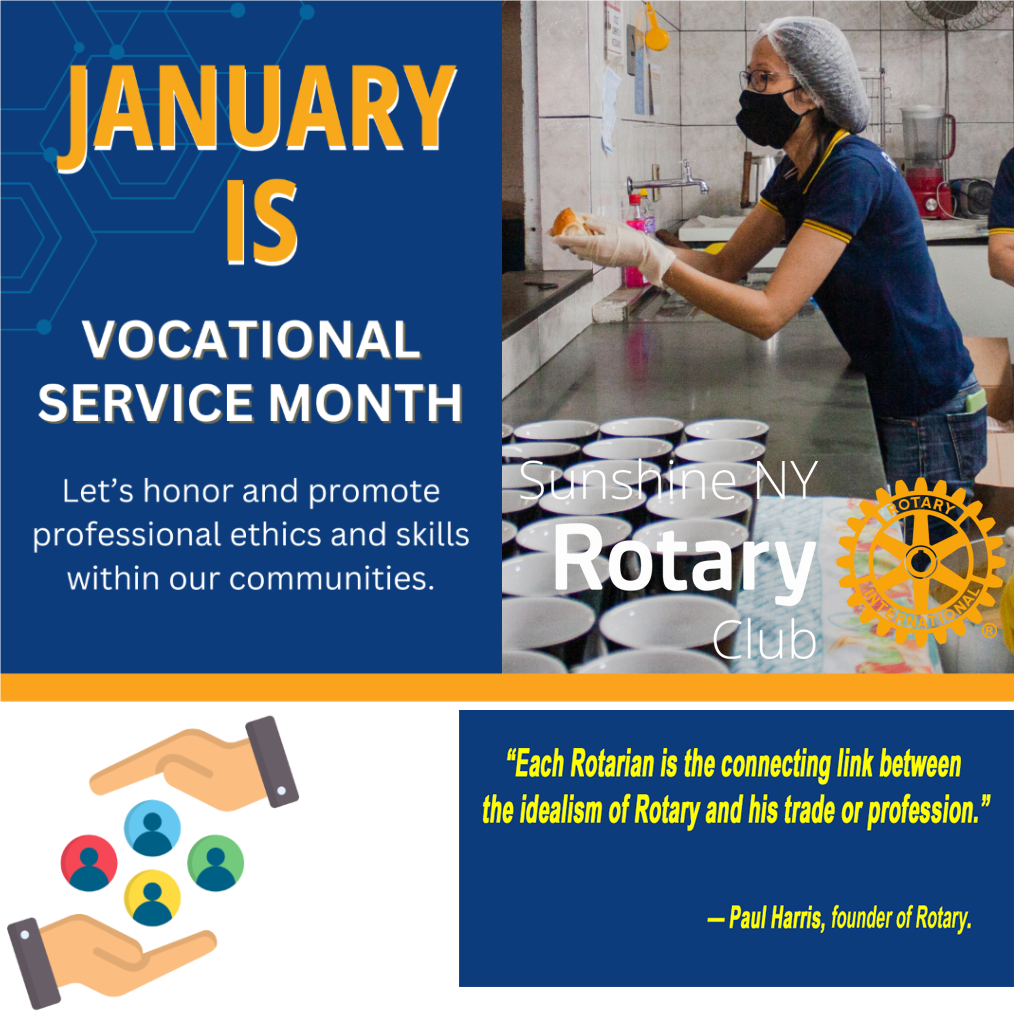
JANUARY IS VOCATIONAL SERVICE MONTH
Putting Our Knowledge, Skills, and Integrity into Service
Each January, Rotary recognizes Vocational Service Month—a time for Rotary and Rotaract members to reflect on how our professions, occupations, experience, and ethical leadership can improve lives and strengthen communities.
Vocational Service is one of Rotary’s five Avenues of Service and one of the qualities that has distinguished Rotary since its earliest years. It asks us to view our work as more than a way to earn a living. Our vocations also provide opportunities to serve others, model integrity, mentor future leaders, and contribute practical solutions to community needs.
Rotary International describes Vocational Service as more than applying professional skills. It also means living Rotary’s values through our work, promoting ethical practices, recognizing the dignity of every useful occupation, and helping others develop professionally.
“Each Rotarian is the connecting link between the idealism of Rotary and his trade or profession.”
— Paul Harris, founder of Rotary.
More Than Vocational Training
Although vocational training is an important Rotary activity, Vocational Service Month is the broader designation.
Vocational training helps people gain the technical and practical skills needed for employment. Vocational Service includes that work, but it also encompasses:
- Ethical conduct in business and professional life
- Respect for all useful occupations
- The application of professional knowledge to community problems
- Career guidance and mentoring
- Leadership development
- Professional networking conducted with integrity
- Recognition of ethical and exemplary workers
- Skills-based volunteering
- Vocational Training Teams
- Helping people discover meaningful employment and career opportunities
January therefore gives clubs an opportunity not merely to organize training programs but to examine how every member’s vocation can become an instrument of service.
Vocational Service Is at the Heart of Rotary
Rotary was founded by people from different professional backgrounds. Paul Harris envisioned a club in which members representing a variety of occupations could exchange ideas, form friendships, and contribute to their community. Rotary’s classification tradition grew from that founding vision of bringing diverse professional perspectives together.
The concept of Vocational Service is rooted in the Second Object of Rotary, which calls on members to encourage and foster:
- High ethical standards in business and professions
- Recognition of the worthiness of all useful occupations
- The dignifying of each Rotarian’s occupation as an opportunity to serve society
Vocational Service therefore has two dimensions.
First, Rotary members are expected to represent the principles of Rotary in their workplaces and professions. Second, they are encouraged to bring their professional knowledge, experience, and relationships into Rotary service.
Every Useful Occupation Has Dignity
Vocational Service is not limited to executives, business owners, doctors, attorneys, educators, or other traditionally recognized professions.
Rotary affirms the worthiness of all useful occupations. Communities depend on caregivers, tradespeople, drivers, technicians, sanitation workers, administrative staff, food-service employees, first responders, health workers, artists, farmers, mechanics, teachers, entrepreneurs, and countless others.
Rotary International recently highlighted a hospital janitor in Uganda who was recognized with a Vocational Service Award because of the extraordinary care and kindness she showed patients and their families. Her example demonstrates that professional excellence is measured not only by title, education, or income, but also by integrity, commitment, competence, and service to others.
Clubs should ensure that vocational recognition reflects the full range of people whose work sustains their communities.
Ethics Begin with Our Own Conduct
Vocational Service challenges Rotary members to examine how we conduct ourselves when no Rotary meeting or service project is taking place.
Do we treat employees, colleagues, customers, competitors, suppliers, and members of the public fairly? Do we communicate truthfully? Do we disclose conflicts of interest? Do we honor our commitments? Do our professional decisions build trust and goodwill?
The Four-Way Test was developed in 1932 by Chicago Rotarian and businessman Herbert J. Taylor as an ethical guide for a company facing bankruptcy. Rotary adopted it in 1943, and it remains one of the organization’s most widely recognized standards of business and personal ethics.
Of the things we think, say, or do:
- Is it the TRUTH?
- Is it FAIR to all concerned?
- Will it build GOODWILL and BETTER FRIENDSHIPS?
- Will it be BENEFICIAL to all concerned?
The Test should first be used as a standard for our own conduct—not as a weapon for judging or criticizing others.
Use Professional Expertise to Solve Community Problems
Many Rotary projects require more than volunteers and financial contributions. They also need technical knowledge, planning, professional judgment, and specialized skills.
Rotary members can contribute as:
- Accountants reviewing budgets and financial controls
- Attorneys advising nonprofit organizations on governance
- Educators developing literacy or vocational curricula
- Health professionals designing evidence-based health initiatives
- Engineers assessing water, sanitation, energy, or construction projects
- Information-technology professionals improving digital access and security
- Communications specialists helping community organizations tell their stories
- Human-resource professionals offering résumé and interview training
- Financial professionals teaching budgeting and financial literacy
- Entrepreneurs mentoring small-business owners
- Project managers developing implementation plans and evaluation systems
- Retired professionals sharing decades of knowledge and experience
Rotary Action Groups also connect members with specialized expertise and global networks. They help clubs assess needs, identify partners, develop technically sound plans, and implement sustainable projects.
Before hiring outside consultants, a club should ask what expertise already exists among its members, Rotaractors, alumni, partner organizations, and professional networks.
Help Young People Explore Their Futures
Choosing a career can be difficult, particularly for young people who have limited exposure to different professions or lack access to mentors and professional networks.
Rotary and Rotaract clubs can help students understand the variety of pathways available to them—not only four-year university programs, but also community colleges, apprenticeships, technical education, public service, entrepreneurship, certification programs, and skilled trades.
A club could:
- Organize a career day at a school or community center.
- Establish a job-shadowing program.
- Match students with professional mentors.
- Arrange workplace and business visits.
- Conduct résumé-writing and interview workshops.
- Help students explore apprenticeships and technical careers.
- Offer vocational or trade-school scholarships.
- Invite professionals from underrepresented careers to speak.
- Support internships and supervised work experiences.
- Conduct mock interviews with constructive feedback.
- Introduce students to careers in public service and nonprofit organizations.
- Help young people identify their interests, strengths, and transferable skills.
Rotary districts commonly recommend career days, job-shadowing, mentoring, workplace tours, vocational scholarships, skills workshops, and student-recognition programs as practical Vocational Service activities.
The objective should not be to pressure young people toward a particular occupation. It should be to broaden their awareness and give them reliable information, encouragement, and access to opportunity.
Mentor Emerging Professionals and Entrepreneurs
Mentorship is one of the most valuable forms of Vocational Service because it transfers knowledge that may have taken decades to acquire.
A mentor can help someone:
- Understand workplace expectations
- Set realistic professional goals
- Develop confidence and leadership skills
- Prepare for difficult conversations
- Build a professional network
- Evaluate career opportunities
- Avoid common business mistakes
- Improve communication and decision-making
- Develop an ethical approach to leadership
- Recognize when additional training is needed
Mentoring relationships should be structured around the participant’s goals rather than the mentor’s assumptions. Clubs should establish clear expectations, appropriate boundaries, suitable safeguarding procedures, and a reasonable period for the mentoring relationship.
District 7070’s current Vocational Service guidance emphasizes mentoring, skills development, ethical business practices, and examples of members using their expertise to serve communities.
Bring Vocational Service into Club Life
Vocational Service should not be limited to one January presentation. It can strengthen fellowship, member engagement, service planning, and membership development throughout the year.
Clubs can:
- Introduce a two- or three-minute “vocation spotlight” at regular meetings.
- Ask new members to give classification presentations.
- Hold a meeting at a member’s workplace.
- Organize tours of local businesses, hospitals, schools, public agencies, and nonprofit organizations.
- Invite members to explain emerging developments in their professions.
- Discuss ethical dilemmas without disclosing confidential information.
- Create a directory of members willing to provide technical guidance to service committees.
- Invite Rotaractors and alumni to discuss their professional aspirations.
- Establish an annual Vocational Service Award.
- Recognize educators, first responders, health workers, tradespeople, caregivers, and other outstanding workers.
- Organize a professional networking event based on Rotary values.
- Partner with a chamber of commerce, library, workforce agency, or business association.
- Invite prospective members to an event where Rotary’s professional diversity is visible.
Classification talks and workplace visits help members understand one another’s expertise and may reveal resources that can strengthen future service projects. Several districts recommend brief member vocation presentations, professional visits, ethical discussions, community awards, and needs-based skills projects.
Network with Integrity
Professional networking has always been part of Rotary’s history, but Rotary networking should be grounded in trust, reciprocity, and service—not aggressive solicitation.
Ethical professional networking can:
- Help members learn about different industries
- Connect job seekers with possible mentors
- Introduce nonprofit organizations to technical advisers
- Identify community partners
- Help young professionals develop relationships
- Connect small businesses with training and resources
- Strengthen collaboration among civic institutions
- Introduce prospective members to Rotary
Members should respect club policies, avoid creating pressure to purchase goods or services, disclose potential conflicts of interest, and ensure that Rotary relationships are never exploited for improper personal gain.
The value of Rotary’s professional network comes from the quality of its relationships and the integrity with which those relationships are maintained.
Support Vocational Education and Skills Development
Vocational education can provide people with practical pathways to employment, financial independence, entrepreneurship, and community leadership.
Strong vocational-training projects begin with evidence about local employment opportunities. Training people in a skill for which there is little market demand may create certificates but not livelihoods.
Before supporting a training program, clubs should ask:
- Which occupations are in demand?
- Have local employers been consulted?
- Is the training recognized or accredited?
- Are instructors appropriately qualified?
- Does the program include practical experience?
- Are tools and materials available?
- Can participants afford transportation and childcare?
- Are women, people with disabilities, immigrants, and other underserved groups able to participate?
- Does the program include job placement or business support?
- How many graduates obtain and retain suitable employment?
- Can the program continue after Rotary funding ends?
Rotary’s highlighted vocational projects combine hands-on learning, community leadership, partnerships, mentoring, and employment pathways rather than offering isolated short-term instruction. One Rotary-supported education-for-employment initiative in Guatemala reports that more than 4,000 students have graduated and that 86 percent have secured employment.
Vocational Training Teams
A Vocational Training Team, or VTT, brings groups of professionals together to teach or learn specialized knowledge in another community or country.
VTTs can support areas such as:
- Maternal and child health
- Nursing and midwifery
- Education and teacher training
- Water and sanitation
- Agriculture
- Public health
- Peacebuilding
- Business development
- Environmental protection
- Engineering and technical maintenance
Rotary describes VTTs as groups of professionals who travel to another country to teach and learn from people in the same field. Depending on the project, a team may be supported through a district grant or global grant.
A successful team should respond to a documented need, work with local professionals, transfer knowledge in both directions, respect local expertise, establish measurable objectives, and provide follow-up after the visit.
The objective is not for outside professionals to arrive as rescuers. It is to build lasting professional capacity through partnership.
Sunshine Rotary in Action
The Rotary E-Club of Sunshine, New York, already has experience with vocational service.
In partnership with the Rotary Club of Banani Dhaka, the Club provided a computer system and three electric sewing machines to an orphanage for girls in Chandpur, Bangladesh. The girls received computer instruction and training in sewing, embroidery, and clothing production.
The project was designed to provide practical, marketable skills and to allow future groups of girls to benefit from the equipment and training. The Club also anticipated that graduates might eventually develop businesses or return to teach other girls.
This initiative demonstrates several important principles:
- Responding to a need identified by the institution and participants
- Combining equipment with instruction
- Developing practical and marketable skills
- Planning for use by future participants
- Encouraging self-reliance and entrepreneurship
- Working through a local Rotary partner
During January, the Club can revisit the project, gather updated information from the orphanage, document outcomes, and determine whether additional training, maintenance, mentoring, or market access would increase its long-term impact.
Recognize Excellence and Integrity
A Vocational Service Award can honor a person who demonstrates professional competence, ethical conduct, compassion, and service to the community.
Potential honorees might include:
- An educator who has transformed students’ lives
- A health worker serving vulnerable families
- A first responder demonstrating exceptional commitment
- A business owner known for fair employment practices
- A tradesperson mentoring apprentices
- A public employee providing outstanding service
- A young professional showing ethical leadership
- A caregiver whose work often goes unrecognized
- An entrepreneur creating opportunities for others
- A worker who has gone beyond the formal requirements of the job
Establish written criteria before selecting a recipient. Avoid choosing someone only because of prominence, friendship, or business connections. The recognition should celebrate the values of Vocational Service rather than function as commercial promotion.
Districts recommend community vocational awards as a way to recognize outstanding professional achievement combined with high ethical standards.
Measure the Difference
Vocational Service should be evaluated by more than the number of workshops held or participants registered.
Depending on the initiative, clubs could measure:
- Participants completing training
- Participants earning recognized credentials
- Graduates obtaining employment
- Participants retaining employment after six or twelve months
- Businesses launched and still operating
- Improvements in income
- Mentoring relationships completed
- Students reporting greater career awareness
- Employers participating in internships or job placement
- People from underserved groups gaining access to training
- Professionals contributing technical service
- Organizations improving their capacity because of Rotary assistance
- Participants assuming leadership or mentoring others
Measurements should be agreed upon with project partners before activities begin. Participant feedback should also be collected so the club can improve the program and understand whether it addressed the intended need.
What Can Your Club Do This January?
Begin by identifying the professional experience already represented in the club.
Ask each member:
- What knowledge or skill could you teach?
- What community organization could benefit from your expertise?
- Whom could you mentor?
- Which profession could you introduce to young people?
- What ethical issue deserves thoughtful discussion?
- Which local worker deserves recognition?
- What professional network could help a service project?
- What skill would you like to learn from another member?
Then select one or two realistic activities that can continue beyond January.
A small mentoring program that produces meaningful relationships may have more impact than a large event with no follow-up. A carefully planned skills workshop may be more valuable than donating equipment that recipients cannot maintain. A workplace discussion about ethical leadership may influence hundreds of future decisions.
Take Action This January
Vocational Service reminds us that Rotary is not confined to club meetings, fundraising events, or scheduled service projects.
It is present in how we conduct our businesses, serve our clients, treat our colleagues, supervise employees, teach students, care for patients, advise organizations, solve problems, and mentor those who follow us.
This January, let us celebrate the dignity of every useful occupation, reaffirm Rotary’s commitment to ethical leadership, and place our professional knowledge at the service of others.
Whether your club mentors one student, recognizes an outstanding worker, organizes a career program, advises a nonprofit organization, supports vocational education, or develops a Rotary Foundation Vocational Training Team, every member has something valuable to contribute.
How will you use your vocation to serve?
Share your club’s vocational programs, mentoring relationships, workplace visits, award presentations, training initiatives, results, and photographs with the District Public Image Team. Together, we can demonstrate how Rotary members transform professional knowledge into lasting community impact.