October is Economic & Community Development Month
Building Opportunity, Strengthening Communities
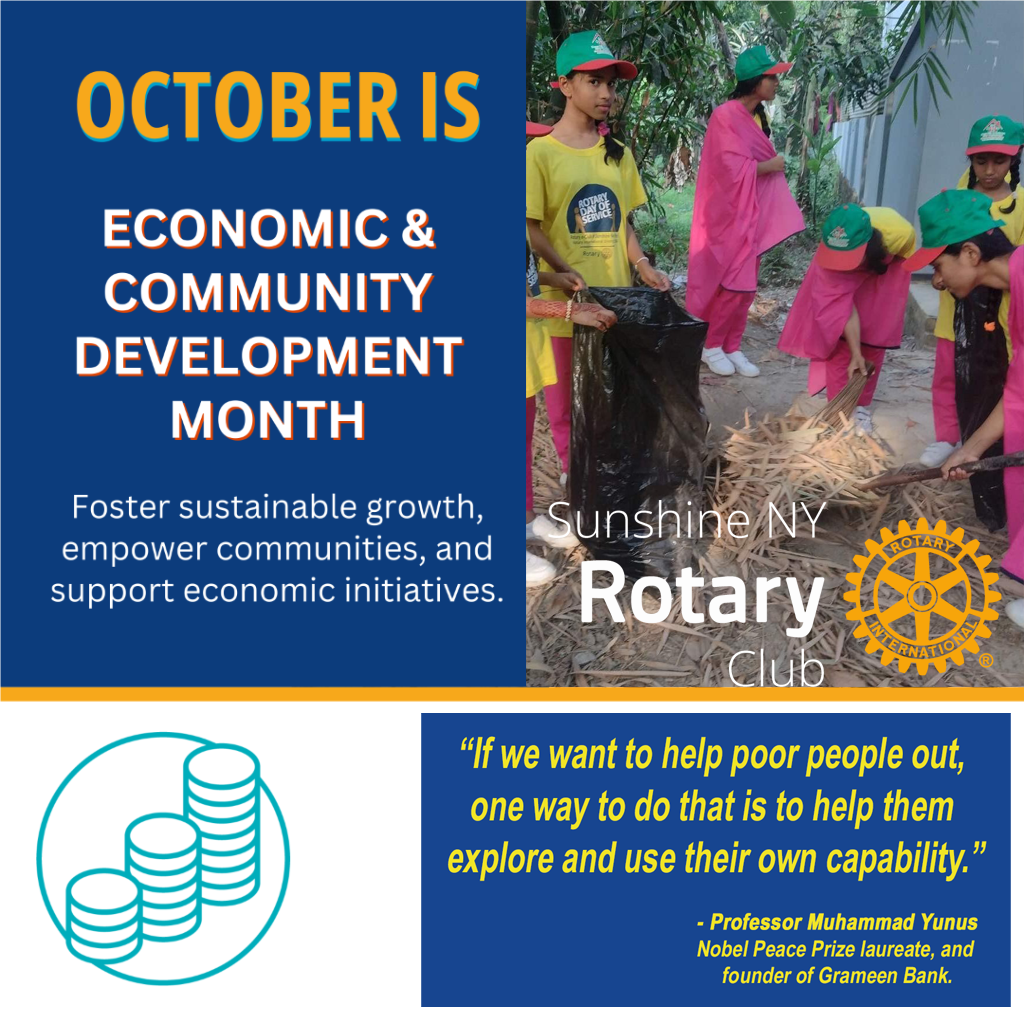
Each October, Rotary recognizes Economic and Community Development Month—an opportunity for Rotary and Rotaract clubs to help people develop the skills, resources, connections, and opportunities they need to improve their lives and strengthen their communities.
Economic development is not simply about increasing income. It is about creating communities where people can find meaningful work, build sustainable businesses, support their families, participate in local decision-making, and look toward the future with confidence.
Rotary’s Community Economic Development area of focus supports sustainable solutions to poverty by strengthening local entrepreneurs and community leaders, particularly women; expanding access to training and productive employment; and improving financial and business-management skills.
“If we want to help poor people out, one way to do that is to help them explore
and use their own capability.”
— Professor Muhammad Yunus, Nobel Peace Prize laureate and founder of Grameen Bank.
Development Begins with the Community
The most successful projects are not imposed on a community from the outside. They begin by listening to the people who live there.
Community members understand their assets, challenges, culture, markets, and priorities. Rotary members can contribute professional knowledge, trusted relationships, organizational experience, mentorship, funding, and access to a global network—but local people should help define the problem and shape the solution.
Rotary requires a community assessment before clubs and districts apply for a global grant supporting a humanitarian project or vocational training team. Global grant projects must address demonstrated community needs, establish measurable goals, involve Rotarians and community members, and include plans for sustainability after grant funding ends.
Before planning a project, clubs should ask:
- What strengths and resources already exist in the community?
- What economic barriers do residents face?
- Which skills are needed by local employers?
- What prevents entrepreneurs from starting or expanding businesses?
- Are women, young people, immigrants, refugees, people with disabilities, and other underserved groups able to participate fully?
- Which local organizations are already addressing these needs?
- What would success look like one, three, or five years after the project begins?
Listening first helps clubs avoid duplicating existing services and ensures that Rotary’s investment supports a locally owned solution.
Invest in People, Not Only Things
Donating equipment or supplies can be helpful, but equipment alone rarely creates lasting economic progress.
A sewing machine has greater value when its recipient also receives technical instruction, business training, mentoring, access to markets, and a plan for maintenance. A computer becomes more useful when it is accompanied by digital-skills training and reliable internet access. A microloan is more likely to succeed when the borrower understands budgeting, recordkeeping, pricing, marketing, and repayment responsibilities.
Rotary projects around the world combine practical resources with training, mentorship, financial literacy, networking, and market access. Rotary International highlights projects that have helped women organize lending groups, provided vocational and business training, and taught farmers how to improve production and market their crops.
The objective should not be temporary assistance. It should be greater self-reliance, dignity, opportunity, and resilience.
What Can Our Club Do?
Economic and community development projects can be local or international, large or small. A meaningful initiative might begin with one workshop, one partnership, or one person willing to share professional expertise.
As a Club we could:
- Organize job-readiness workshops covering résumés, interviews, workplace communication, and digital applications.
- Establish a mentoring program connecting experienced professionals with job seekers, young adults, or new entrepreneurs.
- Offer financial-literacy classes on budgeting, banking, credit, saving, insurance, and responsible borrowing.
- Sponsor digital-skills training for older adults, immigrants, unemployed workers, or small-business owners.
- Support vocational training in trades that match demonstrated local employment opportunities.
- Organize a career fair connecting employers, training institutions, and job seekers.
- Create a youth entrepreneurship program, business-plan competition, or supervised student enterprise.
- Help women entrepreneurs gain access to training, mentorship, professional networks, financing, and markets.
- Partner with refugee- and immigrant-support organizations on language, credentialing, employment, and small-business programs.
- Support cooperatives through appropriate equipment, management training, quality control, and market development.
- Help local farmers improve production, storage, packaging, transportation, and access to markets.
- Purchase project materials and services locally whenever practical, allowing Rotary funds to circulate within the community.
- Invite economic-development professionals, nonprofit leaders, local employers, bankers, educators, and entrepreneurs to speak at club meetings.
- Provide professional expertise to a nonprofit organization or community enterprise that needs assistance with accounting, technology, communications, governance, or strategic planning.
- Develop an international partnership supporting vocational education, entrepreneurship, sustainable agriculture, or community infrastructure.
Other Rotary districts have promoted job-readiness workshops, youth entrepreneurship, financial education, career fairs, vocational training, mentoring, microfinance, and support for local businesses as practical October initiatives.
Use Rotary’s Vocational Strength
Rotary was built on relationships among people from different professions. Economic and Community Development Month gives members an opportunity to put their vocational knowledge directly into service.
Accountants can teach bookkeeping. Bankers and financial professionals can explain credit and cash flow. Human-resource specialists can conduct interview workshops. Attorneys can discuss business structures and regulatory requirements. Technology professionals can teach digital skills. Marketing specialists can help entrepreneurs reach customers. Educators can design training programs. Retired professionals can become mentors.
District 5030, for example, has connected vocational service and economic development through a business network, professional mentoring, leadership development, and initiatives that link commerce with community causes. District 7090 has highlighted programs that combine business education, mentoring, networking, and access to microloans.
When members share their expertise, Rotary provides something more valuable than a donation: knowledge that can continue producing benefits long after a project has ended.
Empower Women and Underserved Groups
Women often invest earnings in their children’s health, education, nutrition, and well-being, multiplying the benefits throughout their families and communities. Yet many women continue to face barriers to financing, property ownership, training, technology, transportation, childcare, professional networks, and formal employment.
Rotary International has featured projects that combine financial literacy, business loans, and individual advising to help women entrepreneurs build sustainable businesses.
Clubs should ensure that women and other underserved populations are not merely recipients of a project but active participants in its planning, leadership, implementation, and evaluation.
A strong project asks not only, “How many people did we serve?” but also:
- Who had a voice in making decisions?
- Who gained leadership responsibility?
- Who acquired a marketable skill?
- Who increased an income or obtained employment?
- Who gained access to financial services or new markets?
- Who is prepared to continue the work?
Build Partnerships That Last
Economic challenges are interconnected and rarely solved by one organization acting alone. Strong projects often involve partnerships with:
- Workforce-development organizations
- Schools, colleges, and vocational institutions
- Chambers of commerce and local business associations
- Banks, credit unions, and community-development financial institutions
- Municipal economic-development agencies
- Libraries and community centers
- Immigrant- and refugee-support organizations
- Organizations serving women, veterans, young people, or people with disabilities
- Agricultural cooperatives and farmers’ associations
- Rotary and Rotaract clubs in other communities
- The Rotary Action Group for Community Economic Development
The Rotary Action Group for Community Economic Development offers expertise to help clubs plan and manage sustainable projects. Its areas of interest include microfinance, vocational education, entrepreneurship, agricultural development, community infrastructure, market access, and value-chain development.
Clubs can also follow Sunshine's example and consider sponsoring a Rotary Community Corps. An RCC brings non-Rotarian community members together with a sponsoring Rotary club to identify needs, contribute local knowledge, and plan sustainable service projects.
Measure Lasting Change
Activity is not the same as impact. Counting workshops, participants, loans, tools, or training hours tells only part of the story.
Depending on the project, we can consider measuring:
- Participants who complete training
- Participants who obtain employment
- New businesses launched and still operating after one or two years
- Existing businesses that increase sales or hire employees
- Improvements in household income
- Loan-repayment and savings rates
- New professional certifications earned
- Farmers who increase production or gain access to new markets
- Women and young people assuming leadership roles
- Participants gaining access to banking, technology, transportation, or childcare
- Community partners continuing the program after Rotary funding ends
Clubs should establish baseline information before a project begins, identify realistic targets, gather participant feedback, and continue evaluating results after the initial activities are completed.
These measurements help Rotary determine what worked, improve future projects, demonstrate accountability to donors, and communicate meaningful impact.
Sunshine Rotary in Action
Sunshine Rotary’s community economic-development work has emphasized practical skills, self-reliance, and investments capable of benefiting people over many years.
Marketable Skills for Orphaned Girls
In partnership with the Rotary Club of Banani Dhaka, Sunshine Rotary provided a complete computer system and three electric sewing machines to the Monu Mia and Sultana Girls Orphanage in Chandpur, Bangladesh.
Thirty girls received introductory computer instruction and training in sewing, embroidery, and clothing production. These are practical skills the participants can use to make clothing, seek employment, earn income, or eventually establish small businesses.
The project was designed for continuing impact. The computer is expected to support several years of learning and remote education, while the sewing machines would serve successive groups of girls for approximately a decade. It was also envisioned that former students may return as instructors, transferring their knowledge to younger girls.
This approach combines:
- Equipment requested by the beneficiary institution
- Technical and practical training
- Continuing use by future participants
- Opportunities for employment and entrepreneurship
- The possibility of graduates becoming mentors and instructors
Supporting Household Stability
The Club’s 2025–26 year-end report also documents member-supported housing assistance for a destitute family in Pukuria, Bangladesh. Early discussions considered combining housing assistance with a small village shop that could provide the family with a continuing source of income. The housing work was completed by May 2026
The lesson from these projects is that effective economic development should go beyond temporary assistance. It should strengthen people’s ability to earn, learn, support their families, and participate more fully in community life.
Let Us Take Action This October
Economic development becomes sustainable when people have the skills, confidence, resources, and freedom to shape their own futures.
This October, let us move beyond short-term relief and invest in opportunity. Let us listen before acting, build on community strengths, engage our professional expertise, support ethical entrepreneurship, and create partnerships that continue producing benefits for years to come.
Whether our club mentors one entrepreneur, teaches a financial-literacy class, supports vocational training, organizes a career fair, sponsors a Rotary Community Corps, or develops a larger grant-funded project, every well-planned action can help build a stronger and more resilient community.
What will your club do to expand economic opportunity?
Share your club’s projects, results, and photographs on your Club page and with with District 7230. By telling these stories, we can recognize our members as People of Action, inspire other clubs, strengthen partnerships, and demonstrate how Rotary service creates lasting community impact.
Rotary Resources
- Rotary International — Growing Local Economies
- Rotary International — Community Assessment Tools
- Rotary International — Global Grants
- Rotary Community Corps
- Rotary Service Project Center
- Rotary Action Group for Community Economic Development
- Economic and Community Development Guidelines for Global Grant Funding